MOBILE SUIT GUNDAM
Mobile Suit Gundam (Japanese: 機動戦士ガンダム Hepburn: Kidō Senshi Gandamu, also known as First Gundam, Gundam 0079 or simply Gundam '79) is a televised anime series, produced and animated by Sunrise. Created and directed by Yoshiyuki Tomino, it premiered in Japan on Nagoya Broadcasting Network and its affiliated ANN stations on April 7, 1979, and lasted until January 26, 1980, spanning 43 episodes. It was the very first Gundam series, which has subsequently been adapted into numerous sequels and spin-offs. Set in the futuristic calendar year "Universal Century" 0079, the plot focuses on the war between the Principality of Zeon and the Earth Federation, with the latter unveiling a new giant robot known as the RX-78-2 Gundam piloted by the teenage civilian mechanic Amuro Ray.
In 1981, the series was re-edited for theatrical release and split into three movies. The characters were designed by Yoshikazu Yasuhiko, and Kunio Okawara was responsible for the mechanical designs, including the eponymous giant robot, the RX-78-2 Gundam. The first movie was released on February 22, 1981. Tomino himself also wrote a trilogy of novels that retell the events of the series. Two manga adaptations of the series have also been written by two manga artists.
Despite initial low ratings that caused the series' cancellation, the popularity of Gundam saw a boost from the introduction of Bandai's Gunpla models in 1980 and from reruns and the theatrical release of the anime, leading to the creation of a prolific and lucrative media and toy franchise. The series is famous for revolutionizing the giant robot genre due to the handling of mobile suits as weapons of war as well as the portrayal of their pilots as ordinary soldiers, as opposed to the previous style of portraying hero pilots and their giant super hero robots.
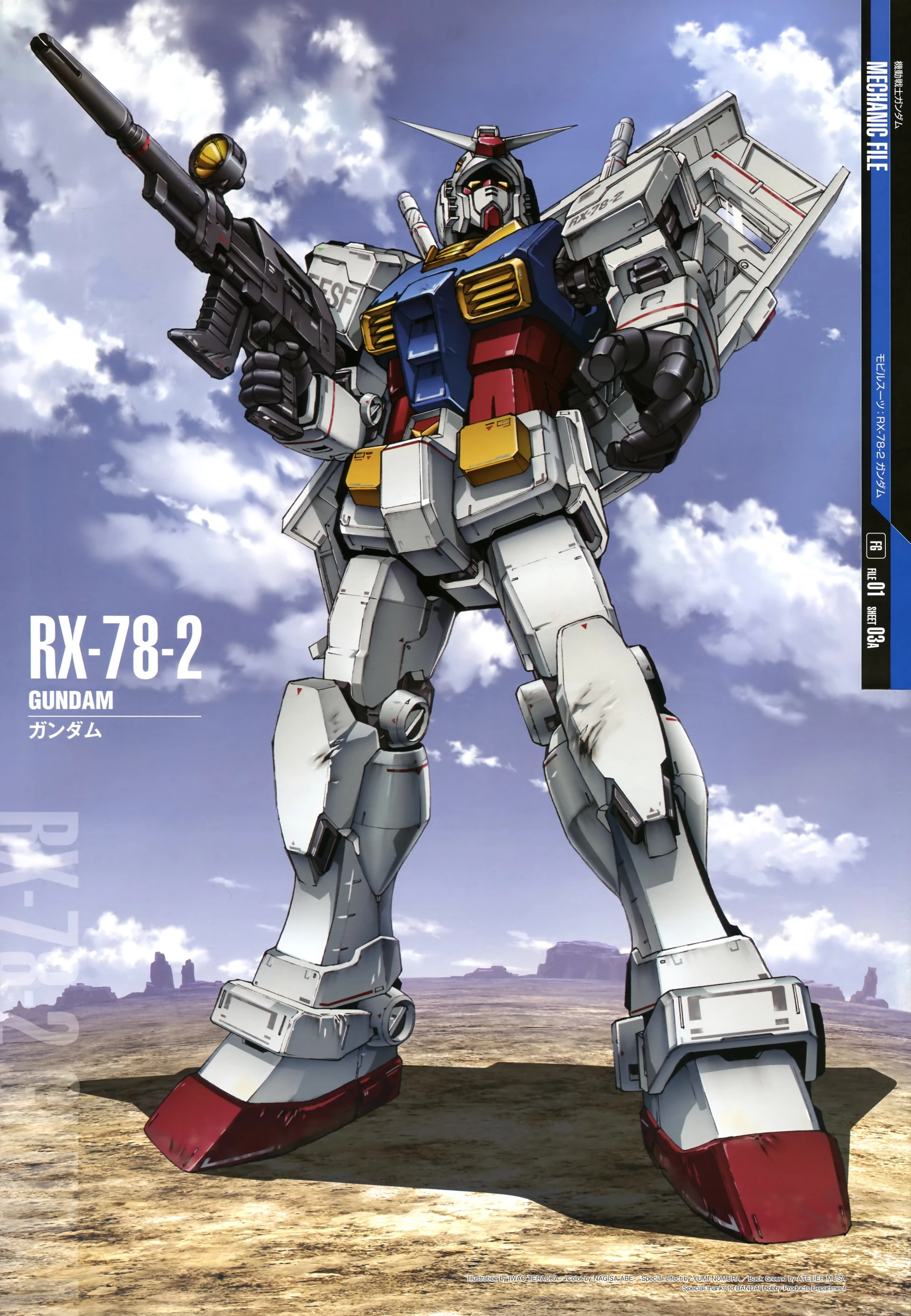
The RX-78-2 Gundam (aka the Gundam or White Mobile Suit) is the titular mobile suit of Mobile Suit Gundam. Part of the RX-78 Gundam series, it was built in secret on Side 7. The Gundam would turn the tide of war in favor of the Earth Federation during the One Year War against the Principality of Zeon. The unit was primarily piloted by the series' main protagonist Amuro Ray.
The Gundam was incredibly advanced for its time. Built from lightweight Luna Titanium Alloy, its frame was both lighter than that of Zeon's mass-produced mobile suits and much sturdier, able to shrug off a Zaku II's machine gun fire with little to no damage. Its offensive power was above and beyond that of the Zeon Zakus. The Gundam would engage in most battles with its beam rifle making it the first mobile suit to have firepower equivalent to a battleship beam cannon. In addition, it made use of two beam sabers, blades of extremely hot plasma which could cut through any metal with ease. Those beam sabers could be extended into a spear-like beam javelin, which could be used to stab into an enemy from a longer distance than the blade of the saber would allow.
The Gundam also used more conventional weaponry: it could launch rockets with a "Hyper Bazooka," the Federation's answer to the bazookas used by Zeon's Zakus; in addition, its head was outfitted with a pair of small vulcan cannons, providing it with a last resort weapon as well as a way of attacking light-armored aircraft and vehicles without wasting ammo or energy from its more powerful armaments. It also made use of a very unconventional close-range weapon known as the "Gundam Hammer" - a large weapon similar to a flail which could be swung at enemies to deal crushing damage. The Gundam Hammer was eventually upgraded for use in space and outfitted with a number of verniers on the ball, and renamed to be the "Hyper Hammer". Lastly, it wielded a large shield which would offer it a defense against enemy attacks that not even its Luna Titanium body could withstand without damage. Gundam pilot Amuro Ray would make use of the shield as a decoy in many battles, taking advantage of its size to fool the enemy into thinking he was charging at them, then attacking the enemy through the shield.
In terms of technology, the Gundam was equipped with a sophisticated Learning Computer which would collect pilot and enemy data during skirmishes and allow the Gundam to operate more effectively. The data from the computer was used by the Federation to improve the controls of the Gundam's mass-produced form, the RGM-79 GM. In addition, it was upgraded by Federation technician Mosque Han shortly before the Battle of A Baoa Qu to improve its reaction times, the joints of the Gundam were given a Magnetic Coating, based on the experimental procedure performed on the RX-78-3 "G-3" Gundam and later used Amuro's intended successor unit, the RX-78NT-1 Gundam "Alex".
The Gundam makes use of the Core Block System implemented in the other V Project units. The torso of the Gundam is mostly hollow so that a FF-X7 Core Fighter can dock with it. This allows the pilot to jettison the legs and torso of the Gundam should the Gundam be too heavily damaged and gives the pilot a chance to escape from battle.
Later, during Operation Odessa, the Gundam is given a support unit known as the G-Fighter. The two G-Fighters were designed to take advantage of the Gundam's modular system and diversify the Gundam's role in active combat. These modes ranged from the assault bomber G-Armor to the close combat support tank G-Bull.
Mobile Suit Gundam (Japanese: 機動戦士ガンダム Hepburn: Kidō Senshi Gandamu, also known as First Gundam, Gundam 0079 or simply Gundam '79) is a televised anime series, produced and animated by Sunrise. Created and directed by Yoshiyuki Tomino, it premiered in Japan on Nagoya Broadcasting Network and its affiliated ANN stations on April 7, 1979, and lasted until January 26, 1980, spanning 43 episodes. It was the very first Gundam series, which has subsequently been adapted into numerous sequels and spin-offs. Set in the futuristic calendar year "Universal Century" 0079, the plot focuses on the war between the Principality of Zeon and the Earth Federation, with the latter unveiling a new giant robot known as the RX-78-2 Gundam piloted by the teenage civilian mechanic Amuro Ray.
In 1981, the series was re-edited for theatrical release and split into three movies. The characters were designed by Yoshikazu Yasuhiko, and Kunio Okawara was responsible for the mechanical designs, including the eponymous giant robot, the RX-78-2 Gundam. The first movie was released on February 22, 1981. Tomino himself also wrote a trilogy of novels that retell the events of the series. Two manga adaptations of the series have also been written by two manga artists.
Despite initial low ratings that caused the series' cancellation, the popularity of Gundam saw a boost from the introduction of Bandai's Gunpla models in 1980 and from reruns and the theatrical release of the anime, leading to the creation of a prolific and lucrative media and toy franchise. The series is famous for revolutionizing the giant robot genre due to the handling of mobile suits as weapons of war as well as the portrayal of their pilots as ordinary soldiers, as opposed to the previous style of portraying hero pilots and their giant super hero robots.
The RX-78-2 Gundam (aka the Gundam or White Mobile Suit) is the titular mobile suit of Mobile Suit Gundam. Part of the RX-78 Gundam series, it was built in secret on Side 7. The Gundam would turn the tide of war in favor of the Earth Federation during the One Year War against the Principality of Zeon. The unit was primarily piloted by the series' main protagonist Amuro Ray.
The Gundam was incredibly advanced for its time. Built from lightweight Luna Titanium Alloy, its frame was both lighter than that of Zeon's mass-produced mobile suits and much sturdier, able to shrug off a Zaku II's machine gun fire with little to no damage. Its offensive power was above and beyond that of the Zeon Zakus. The Gundam would engage in most battles with its beam rifle making it the first mobile suit to have firepower equivalent to a battleship beam cannon. In addition, it made use of two beam sabers, blades of extremely hot plasma which could cut through any metal with ease. Those beam sabers could be extended into a spear-like beam javelin, which could be used to stab into an enemy from a longer distance than the blade of the saber would allow.
The Gundam also used more conventional weaponry: it could launch rockets with a "Hyper Bazooka," the Federation's answer to the bazookas used by Zeon's Zakus; in addition, its head was outfitted with a pair of small vulcan cannons, providing it with a last resort weapon as well as a way of attacking light-armored aircraft and vehicles without wasting ammo or energy from its more powerful armaments. It also made use of a very unconventional close-range weapon known as the "Gundam Hammer" - a large weapon similar to a flail which could be swung at enemies to deal crushing damage. The Gundam Hammer was eventually upgraded for use in space and outfitted with a number of verniers on the ball, and renamed to be the "Hyper Hammer". Lastly, it wielded a large shield which would offer it a defense against enemy attacks that not even its Luna Titanium body could withstand without damage. Gundam pilot Amuro Ray would make use of the shield as a decoy in many battles, taking advantage of its size to fool the enemy into thinking he was charging at them, then attacking the enemy through the shield.
In terms of technology, the Gundam was equipped with a sophisticated Learning Computer which would collect pilot and enemy data during skirmishes and allow the Gundam to operate more effectively. The data from the computer was used by the Federation to improve the controls of the Gundam's mass-produced form, the RGM-79 GM. In addition, it was upgraded by Federation technician Mosque Han shortly before the Battle of A Baoa Qu to improve its reaction times, the joints of the Gundam were given a Magnetic Coating, based on the experimental procedure performed on the RX-78-3 "G-3" Gundam and later used Amuro's intended successor unit, the RX-78NT-1 Gundam "Alex".
The Gundam makes use of the Core Block System implemented in the other V Project units. The torso of the Gundam is mostly hollow so that a FF-X7 Core Fighter can dock with it. This allows the pilot to jettison the legs and torso of the Gundam should the Gundam be too heavily damaged and gives the pilot a chance to escape from battle.
Later, during Operation Odessa, the Gundam is given a support unit known as the G-Fighter. The two G-Fighters were designed to take advantage of the Gundam's modular system and diversify the Gundam's role in active combat. These modes ranged from the assault bomber G-Armor to the close combat support tank G-Bull.
Armaments
- 60mm Vulcan Guns
- Mounted in the head the pair of Vulcan guns were 60mm Gatling Guns and have a high rate of fire. Primarily used to ward off advancing enemies, shoot down missiles or other fast moving targets, they also made good use as an anti-aircraft and anti-personnel weapons. The Vulcan guns however had a hard time piercing heavy armor (though they had shown the ability to do severe damage to Mobile Suit's if fired at point-blank range)and thus were not often used against larger, more heavily armored foes.
- Beam Sabers
- The Gundam was the first mobile suit to ever use a beam-oriented weapon in melee combat. The sabers are stored on the backpack, and can transform from saber to the "Gundam Javelin," a large pole with a three pronged beam at the end. The beam sabers use Minovsky particles held in place by an I-Field to form an effective cutting surface that can slice through nearly any material. The particles for the beam sabers are stored by E-cap in the hilt of the saber, which is recharged from the Gundam's reactor when the saber is returned to its socket. Once activated, beam sabers do not rely on the mobile suit's reactor and can be thrown or discarded as decoys. The beam saber is most often used for close range combat or as an emergency weapon once all other ammunition has been depleted. One can be used as a reserve weapon, or both can be used simultaneously in a twin sword fashion.
- Beam Javelin
- The beam javelin is an alternative to the beam saber, it has a higher output than the standard beam saber, and the beam's shape allows for a greater amount of armor penetration ability. The long reach of the weapon gives the RX-78-2 a considerable advantage in close quarters combat.
- Gundam Hammer/Hyper Hammer
- The Gundam Hammer is essentially a large spiked ball attached to a chain, and provides the Gundam with a ranged melee weapon. The Gundam could either throw or swing the Hammer around itself in order to impact and damage its target through the sheer mass of the hammer. Later, it was upgraded into the Hyper Hammer and had several rockets mounted into the ball in order to allow it to maneuver more effectively in space as well as the ability to change its direction before impact, and to increase the damage it could cause.
- BAUVA*XBR-M-79-07G Beam Rifle
- A revolutionary weapon for it's time, the beam rifle is the primary weapon used by the Gundam. Making use of the Federations E-cap (or "energy capacitor") technology, the rifle uses charged concentrations of Minovsky particles as ammunition. This gives the beam rifle firepower equivalent to that of a battleship's beam cannons. As the Minovsky particles destroy matter on a molecular scale, the beam rifle can penetrate even the thickest armor and destroy its target with a single shot. One weak point of the rifle was its energy limits. The rifle could only be fired 16 times before depleting its energy and becoming useless.
- BLASH*XHB-L-03/N-STD Hyper Bazooka
- Technically a large rocket launcher it could fire several 380mm missiles to attack targets at long range. No mass-production MS's armor is able to stop this weapon. While very powerful, it has a slow rate of fire and a fairly little amount of ammunition. Most often used to take out slow, heavily armored targets.
- RX*M-Sh-008/S-01025 Shield
- Hand-carried, forearm-mounted or stored on the Gundam's backpack, the shield is a simple defense used to block most incoming ballistic and explosive projectiles. Also used to great effect in close quarters battle with enemy mobile suits. Has a view port than can be sealed off with an internal blast plate. The shield is also used to deflect heat away from the mobile suit when undergoing atmospheric re-entry.
Special Equipment & Features
- The prototype mobile suits produced by the Earth Federation Forces' Operation V, are equipped with a central block which houses the mobile suit's cockpit, control systems and main power source. This core block can eject in case of emergency and unfold into a small Core Fighter.
- Hardpoints
- An attachment point for weapons, shields, spare ammunition, or optional mission-specific equipment. Hardpoints can also be used to store carried weapons when a mobile suit needs its manipulators free for other purposes.
- Learning Computer
- A critical component of the Gundam's success in combat, the Learning Computer System was similar to a modern day black box. It recorded the data from each of the Gundam's battles for further use. However, the system could also actively learn and improve the capabilities of the Gundam. This was conceived of as a means to get around the difficulty of training pilots. The computer could apply various programs for walking, fighting, and working to the case at hand, independently reaching decisions and making improvements. Once adequate data had been accumulated, the programs could be transplanted, allowing even a machine operated by a novice to perform like a veteran pilot.
- Heatproof Field
- A system installed in the RX-78-2 Gundam, which pumps out air to counter the friction heat of atmospheric entry. The mobile suit's internal cooling systems must also be engaged to deal with the heat that penetrates the air field.
- Magnetic Coating
- A special membrane treatment applied to mobile suit joints to improve their response speed. The mobile suits developed by the Earth Federation Forces use special actuators called field motors, whose efficiency is increased by the magnet coating process. The treatment also reduces friction resistance in the mobile suit's joints. First tested on the RX-78-3 Gundam, this process is then applied to the RX-78-2 used by Amuro Ray, reducing the time required for changes of direction by roughly 27%.
Comments
Post a Comment